
Understanding Al Sa’fat, LEED and the Patterns Emerging from REIDIN Property Research
By: Naseem Zubair Warsi
Senior Data Analyst, Real Estate Research and Market Intelligence, REIDIN
Understanding Green Buildings in Dubai
Green buildings are designed and operated to use resources more efficiently while reducing their environmental impact. They consider factors such as energy consumption, water efficiency, building materials, indoor air quality and the comfort of occupants.
In Dubai, the development of green buildings is shaped by both local regulations and international certification systems. Al Sa’fat, introduced by Dubai Municipality, establishes the emirate’s local green building requirements. LEED, developed by the U.S. Green Building Council (USGBC), provides an internationally recognised framework for assessing building sustainability.
Although both systems address environmental performance, they have different purposes, assessment criteria and levels of application. Al Sa’fat establishes the local regulatory baseline, while LEED provides a voluntary certification that can be used as an additional benchmark.
This article examines how these systems operate in Dubai and explores the patterns emerging from REIDIN’s green building research, including certification levels, property types, geographical distribution and projects currently registered or targeting certification.

1. Two Certification Systems, Different Roles
Al Sa’fat and LEED assess several similar aspects of building performance, but they serve different purposes.
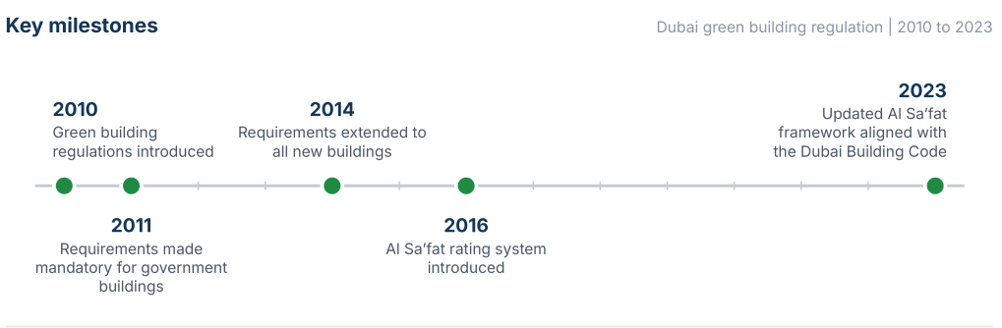
Al Sa’fat is Dubai Municipality’s green building rating system. It builds on green building regulations introduced in 2010, which became mandatory for government buildings in 2011 and for all new buildings in 2014. The municipality introduced the Al Sa’fat rating system in 2016 and issued an updated version in 2023 to align it with the Dubai Building Code.
Silver Sa’fa is the mandatory baseline for new buildings in Dubai, while Gold and Platinum are optional higher ratings. The system reflects local climatic conditions, with particular attention to building design, heat gain, cooling requirements, energy and water efficiency.
LEED (Leadership in Energy and Environmental Design) is issued by the U.S. Green Building Council. Unlike Al Sa’fat, it is voluntary in Dubai and is not a requirement for obtaining a building permit.
Developers may pursue LEED certification to demonstrate a building’s environmental performance against an internationally recognised framework. The certification can also provide a familiar reference for international investors, multinational occupiers and other organisations assessing building sustainability.
Al Sa’fat and LEED: A comparison
| ASSESSMENT AREA | AL SA’FAT | LEED |
| Issued by | Dubai Municipality | U.S. Green Building Council |
| Status in Dubai | Silver is the mandatory baseline; Gold and Platinum are optional | Voluntary |
| Certification levels | Silver, Gold and Platinum | Certified, Silver, Gold and Platinum |
| Main focus | Local climate, building envelope, solar heat gain, cooling requirements, energy and water | Energy, water, materials, indoor environmental quality, site and transport |
| Primary role | Local regulatory and building performance framework | International sustainability assessment and certification |
Table 1. Al Sa’fat and LEED: a comparison
The two systems overlap in areas such as energy efficiency, water conservation, commissioning and sustainable materials. Where developers intend to pursue both, considering the requirements during the design stage can help coordinate the assessment process and documentation.
2. Dubai’s Green Building Regulatory Framework
Dubai’s green building framework has developed progressively over more than a decade. The introduction of regulations in 2010 established the foundation, followed by mandatory requirements for government buildings in 2011 and all new buildings in 2014.
The introduction of Al Sa’fat in 2016 provided a formal rating system, while the 2023 update aligned the framework with the Dubai Building Code.
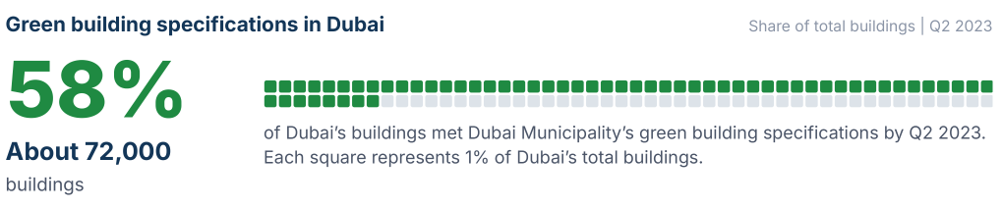
Dubai Municipality figures, published in December 2023, reported that approximately 72,000 buildings, representing 58% of the emirate’s total, met the municipality’s green building specifications by the second quarter of 2023.
The municipality also published estimated energy savings associated with the different Al Sa’fat levels:
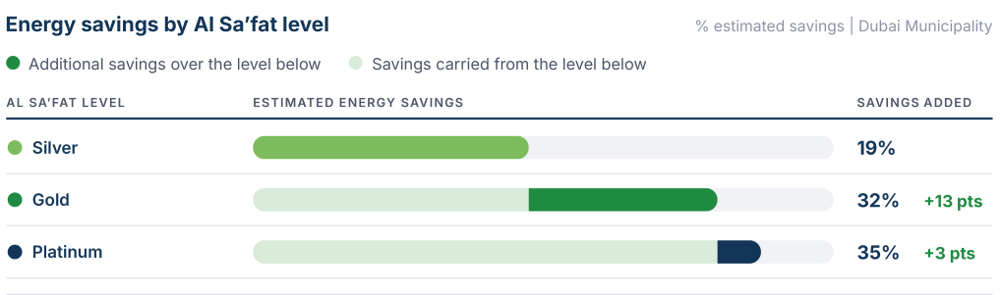
According to these estimates, the difference between Silver and Gold is 13 percentage points, while the difference between Gold and Platinum is three percentage points.
3. Understanding LEED Certification Levels
LEED uses a points based assessment system to determine a building’s certification level. The level awarded depends on the points achieved against the applicable assessment criteria.
The published certification thresholds are:
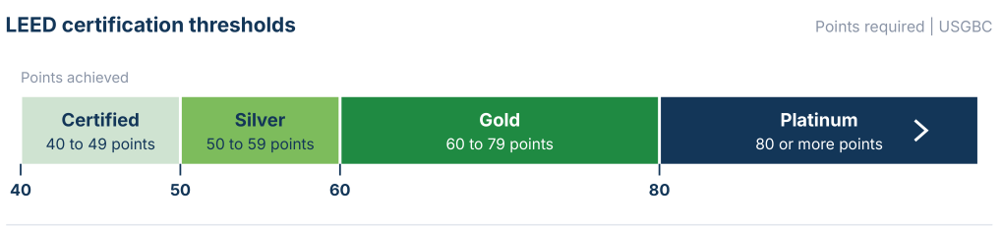
The four levels provide a framework for distinguishing the extent to which a building meets LEED’s assessment requirements.
It is important to distinguish between an awarded certification and a project that is still registered or targeting a particular level. Registration indicates that a project has entered the certification process; it does not mean that the project has already achieved certification.
Understanding the key terms
Some of the terminology used in green building assessments can be unfamiliar to property owners and general readers.
| Green building | A building designed to use resources more efficiently and reduce its environmental impact. |
| Building envelope | The physical separation between a building’s interior and exterior. It includes walls, roofs, windows and insulation, and influences how heat enters or leaves the building. |
| Commissioning | The process of checking and testing building systems, such as air conditioning, lighting and ventilation, to ensure they operate as intended. |
| Indoor environmental quality | Factors affecting the indoor environment, including air quality, ventilation, lighting and occupant comfort. |
| LEED certification | An assessment and certification framework that recognises a building’s performance against defined sustainability criteria. |
4. What REIDIN’s Green Building Data Reveals
REIDIN’s green building dataset contains 337 property records covering different certification statuses. Of these, 281 records have an awarded LEED certification level, while the remaining 56 are either registered or targeting a named level.
The breakdown is as follows:
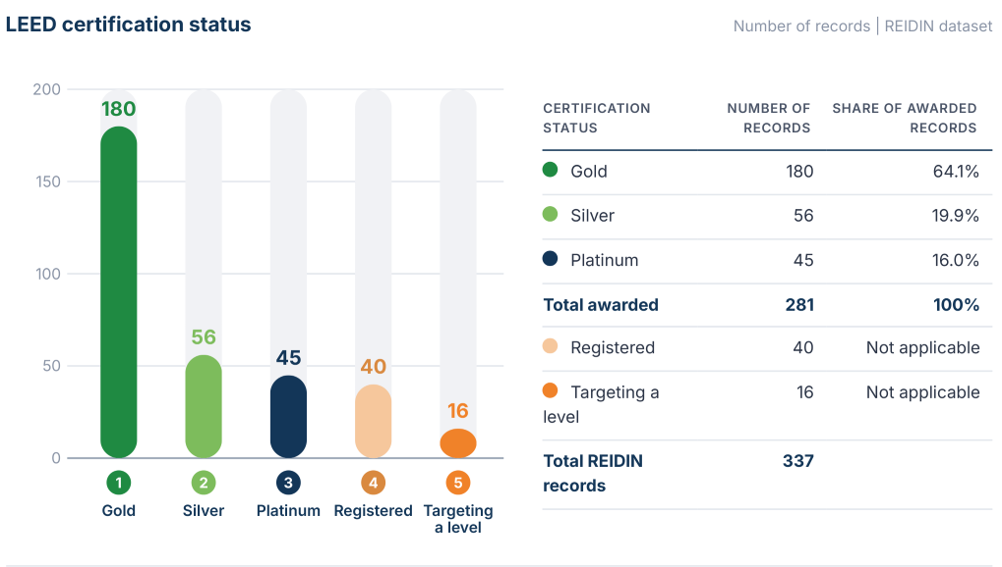
Gold is the most common certification level in the awarded records, accounting for 64.1% of the 281 records. Silver represents 19.9%, while Platinum accounts for 16.0%.
This shows a clear concentration of recorded certifications at the Gold level. However, the available REIDIN data identifies the certification levels achieved, not the reasons behind them.
The distinction between the three statuses is important:
| Awarded | USGBC has certified the project at a named level. |
| Registered | The project is enrolled with USGBC but has not yet received an awarded level. |
| Targeting | The project has stated the certification level it intends to achieve. |
A REIDIN record represents one entry in the dataset. It may refer to an individual building, a development phase or an entire community. Therefore, the total should be understood as property records rather than a count of 337 separate buildings or distinct projects.
5. LEED Gold Distribution Across Dubai
The July 2026 REIDIN extract identifies 173 LEED Gold property records located in Dubai. Offices account for the largest share, followed by residential properties.
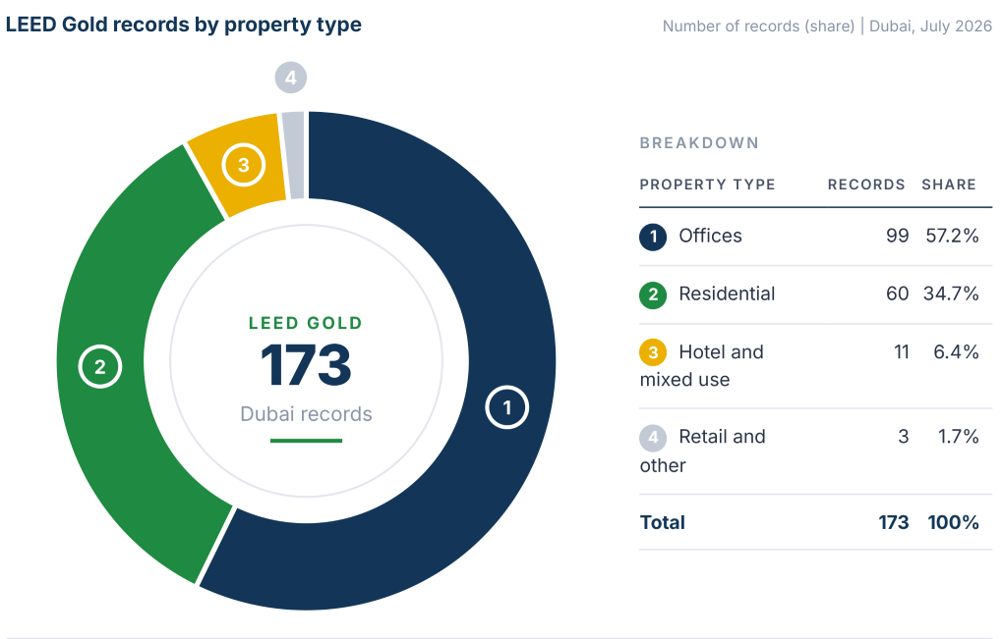
Offices represent 57.2% of the recorded LEED Gold properties, while residential buildings account for 34.7%. Hotel and mixed use properties make up a further 6.4%, with retail and other property types representing the remaining 1.7%.
The distribution provides an overview of the property types represented in REIDIN’s Dubai records. It shows that office properties currently account for the largest share of recorded LEED Gold certifications, although residential properties also represent a substantial part of the dataset.
6. Where LEED Gold Buildings Are Located
The geographical distribution provides another perspective on Dubai’s LEED Gold certified property landscape.
Tecom Business Park, which includes Dubai Internet City and Dubai Media City, has 32 recorded properties, while DIFC has 28. Together, these areas account for 60 records, representing 34.7% of the 173 Dubai records. Of these 60 properties, 53 are offices.
Other areas with recorded LEED Gold properties include Dubai Land, Downtown Dubai, Jumeirah Village Circle, DAFZA, MBR City and Jumeirah Lake Towers.
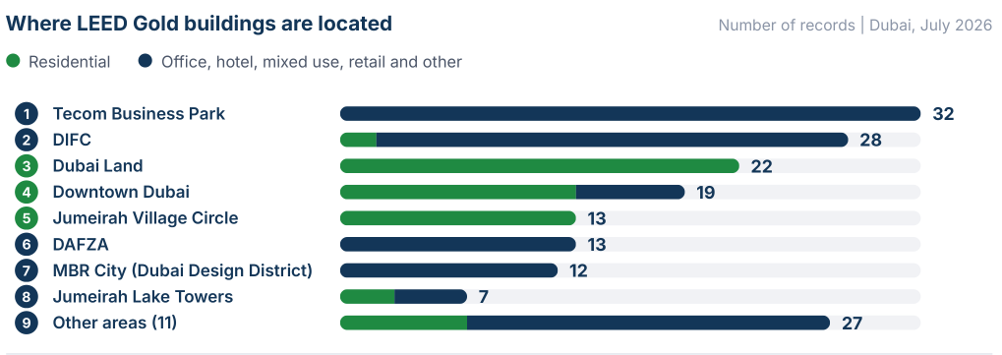
Residential distribution
The residential records show a concentration in a smaller number of locations. Dubai Land accounts for 22 records, while Downtown Dubai and Jumeirah Village Circle each account for 13. Together, these three locations represent 48 of the 60 residential records, or 80%.
The records are associated with six communities:
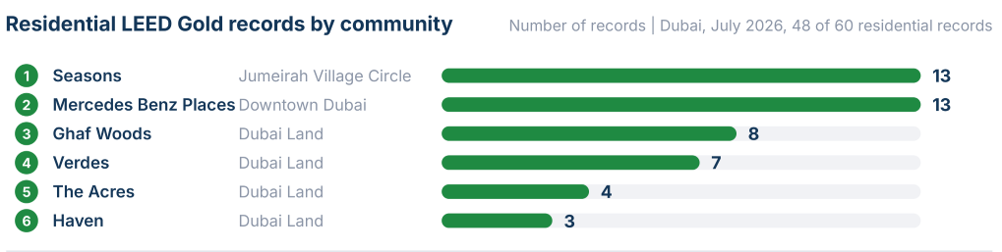
These figures should be interpreted carefully. REIDIN’s records may include individual buildings, development phases and community level entries. Some communities may therefore appear through more than one type of record. The figures measure dataset entries rather than a count of distinct projects.
Overall, the geographical distribution shows a concentration of office records in established business districts, while residential records are concentrated in a smaller group of communities. This describes the current distribution within the REIDIN dataset.
7. Registered and Targeted LEED Projects
Beyond the properties with awarded certification, REIDIN’s dataset also identifies projects that are registered or targeting a named LEED level.
Of the 337 records, 40 are registered without an awarded level and 16 are targeting a named certification level. Together, these 56 records provide an indication of the projects currently represented in the dataset’s certification pipeline.
Dubai Media City has the largest group, with 12 registered records. Sobha Hartland has eight records, seven of which are targeting a named level. Other locations represented include Business Bay, Jumeirah Village Circle, Dubai Maritime City, DIFC, Palm Jumeirah, Downtown Dubai, Dubai Harbour, Dubai Land and Jumeirah Lake Towers.
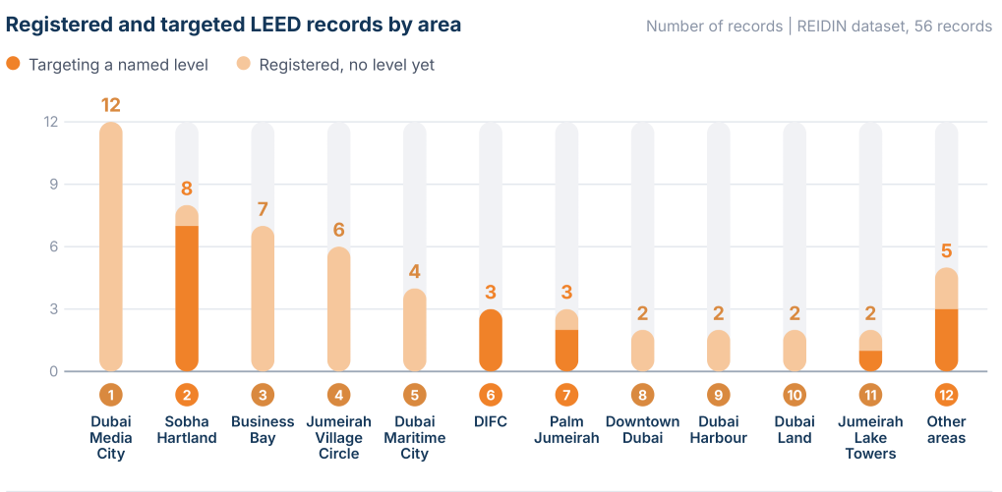
The status of these projects may change as they progress through the certification process. Registration or a stated target should not be treated as confirmation that a project will achieve its intended certification level.
There are three indicators worth monitoring in future REIDIN updates:
1 Pipeline progress: Whether registered and targeted records move to awarded certification levels.
2 Certification distribution: Whether Gold remains the most common awarded level as additional records are added.
3 Geographical and property type distribution: Whether the mix of certified office, residential and other property records changes over time.
These indicators can help track how the recorded certification landscape develops across Dubai.
8. What Certification Means for Developers and Residents
For developers, Al Sa’fat and LEED provide two frameworks through which building performance can be assessed. Al Sa’fat establishes the local regulatory baseline, while LEED offers an additional international certification framework.
Where both systems are being considered, early coordination can help developers understand the requirements, identify areas of overlap and organise the necessary documentation. This may involve appointing consultants familiar with both systems, setting realistic certification targets and involving suppliers early in the design and construction process.
For homeowners and tenants, certification can provide additional information about a building’s assessed environmental performance. Areas such as insulation, glazing, cooling systems, water efficient fixtures, ventilation and material selection can influence how a building performs.
Potential practical benefits include more efficient energy and water use, improved indoor air conditions and more consistent indoor temperatures. Actual results, however, depend on building design, construction quality, maintenance, occupancy and day to day operation.
Conclusion: Dubai’s Evolving Green Building Landscape
Dubai’s green building framework has developed from the introduction of regulations in 2010 to a system in which Al Sa’fat Silver provides the mandatory baseline for new buildings. Alongside this local framework, voluntary LEED certification provides an additional international benchmark for assessing environmental performance.
REIDIN’s property research offers a closer look at how LEED certification is currently represented across Dubai. The 337 record dataset shows that Gold is the most common awarded level, while the July 2026 extract identifies offices as the largest property type category among Dubai’s 173 LEED Gold records. Residential records are also present, with a concentration across six identified communities.
The registered and targeted records provide a further view of projects that may progress through the certification process, although their eventual certification outcomes remain to be seen.
As Dubai’s building regulations and sustainability requirements continue to develop, tracking certification levels, property types and geographical distribution will help provide a clearer picture of the emirate’s changing green building landscape.