
By: Mrs. Rashida Muffadal | Senior Data Analyst, Real Estate Research and Market Intelligence at REIDIN, specialist in market intelligence, project launch tracking, pricing dynamics and payment structure analysis
1. The Structure Behind The Sale
A payment plan divides the price of a property into stages: a down payment at booking, instalments during construction, a payment on handover and, on some plans, instalments after handover. Off-plan sales have become a defining feature of Dubai’s residential market, and payment plans are the key mechanism that enables these transactions. When buyers commit to homes years before completion, they fund a portion of development over time. The payment schedule therefore influences the initial capital required, the buyer’s cash-flow profile and the developer’s funding structure.
For developers, payment plans serve both a financing and a market-access function. Instalments from off-plan buyers are deposited into project escrow accounts and released in line with construction progress, linking the collection schedule to the project’s funding profile. At the same time, a lower initial payment and a longer instalment period can make a purchase accessible to a broader range of investors and end users. This gives developers another way to compete for demand while maintaining the stated price per square foot.
2. How Regulation And Growth Reshaped The Payment Journey
Dubai’s payment-plan market developed alongside the expansion of off-plan sales and the introduction of rules governing property purchases before completion. In 2002, Dubai opened selected projects and areas to non-UAE buyers, initially offering long-term lease arrangements. The legal framework was formalised in 2006, setting out the ownership rights available to non-UAE nationals, and regulations identified the designated areas.
A further milestone came in 2008, Dubai established the Interim Property Register creating a formal process for recording off-plan sales before completion. That November, Dubai Land Department introduced Oqood, its online system for registering those sales. As the market matured, payment plans developed from straightforward deposits and construction-linked instalments into varied schedules spanning booking, construction and handover, while escrow requirements linked the release of project funds to construction progress.
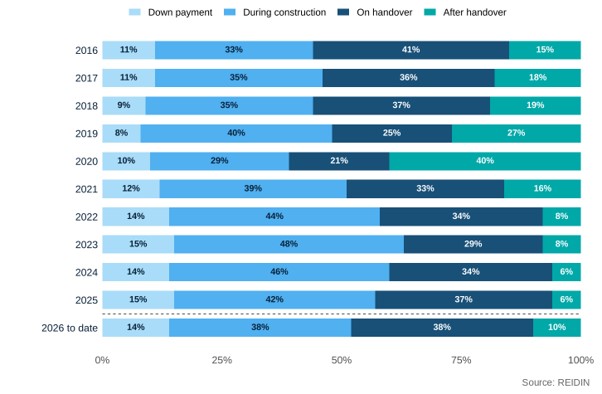
REIDIN’s data on payment offerings shows how these structures have changed. From 2016 to 2020, schedules moved later, with the share due after handover rising from 15% to a peak of 40%. The pattern then reversed: the share due during construction rose from 29% in 2020 to 48% in 2023, while the after-handover share fell to 6% by 2025. In 2026 to date, payments have moved again, from construction (38%) towards handover (38%), with the after-handover share recovering to 10%.
3. One Project, Many Plans: What Buyers Are Actually Offered
A project does not always come with a single payment schedule. Developers may offer buyers different ways to spread the price across the same purchase: one plan may place more weight on payments during construction, while another carries instalments beyond handover. The options can also differ in the initial down payment, giving buyers some choice over both the timing and size of their payments
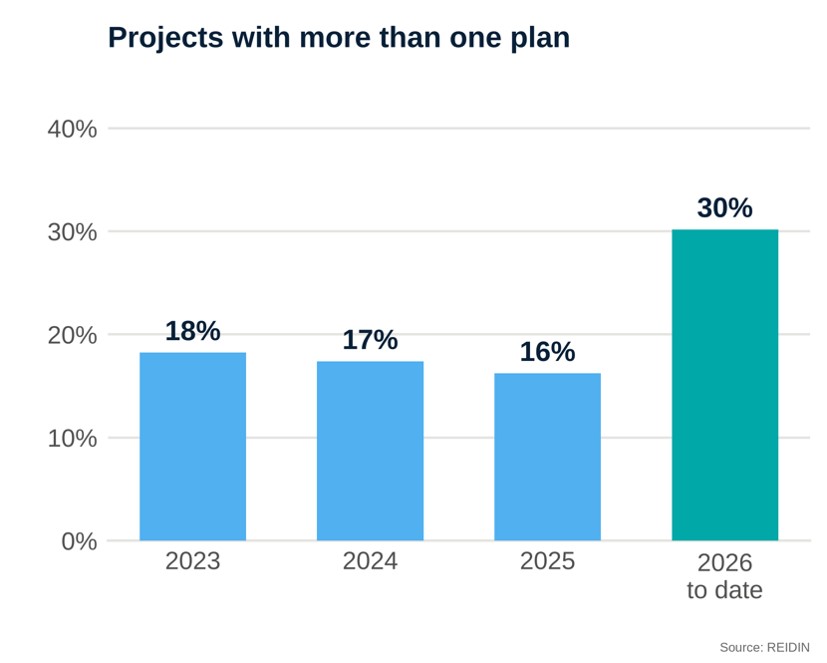
REIDIN’s data indicates a growing prevalence of multiple payment plan options across Dubai’s off-plan market. The share of projects offering more than one plan edged down from 18% in 2023 to 16% in 2025, before rising significantly to 30% in 2026 to date. Among projects offering multiple options, approximately 4 in 10 differentiate their plans through post-handover payment structures, while down-payment requirements vary by an average of around 6 percentage points. The most flexible plan reflects the broadest payment terms available within each project, while alternative options offer varying allocations across upfront, construction-stage and post-handover payments.
4. A Closer Look at 2026: A Step Change in Q2, Then a Plateau
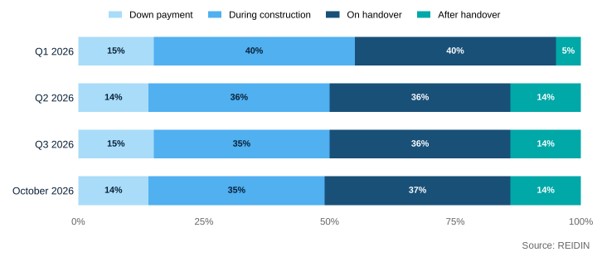
Taking 2026 quarter by quarter shows when the payment schedule shifted and whether the shift has held. The first quarter looked like the years before it. Buyers paid 15% of the price as a down payment, 40% during construction and 40% on handover, and only 5% fell due after handover. Around 55% of the price was therefore paid before the keys were handed over.
The second quarter changed the pattern. The share due after handover rose from 5% to 14%, while the share due during construction fell from 40% to 36% and the share due on handover fell from 40% to 36%. The 9% that deferred beyond handover came in roughly equal parts from construction and handover, and the down payment barely moved. Because of that, the share paid before handover fell from about 55% to about half of the price.
The third quarter consolidated the move rather than extending it. The structure was 15% down payment, 35% during construction, 36% on handover and 14% after handover, almost identical to the second quarter. October looks much the same, at 14%, 35%, 37% and 14%, it continues the pattern, with the schedule holding at its third-quarter shape.
Two points stand out. First, the change was a step between the first and second quarters, not a gradual climb, and it has held through the third quarter and into October. Second, it sits entirely after the down payment: the down payment stayed at 14–15% of the price in every period, so the shift is in how the rest of the price is spread across construction, handover and the period after it.
With payment terms now a visible part of each launch, they will remain a useful indicator of market conditions. Whether the 2026 pattern holds will show in the launches still to come.
5. Bank Financing Expands into the UAE’s Off-Plan Market
Alongside evolving developer payment structures, 2026 has seen UAE banks introduce new financing solutions specifically designed for off-plan property buyers. Traditionally, mortgage finance has been concentrated closer to project completion. The latest offerings bring financing options further into the construction phase, providing alternative routes for buyers to structure their property purchases.
These financing solutions take different forms, including developer-bank partnerships, bank-led pre-approvals and construction milestone-linked financing. Some are developer-bank partnerships, in which a bank and a developer agree an integrated arrangement covering the buyer from booking to handover. Others are bank-led pre-approvals, in which eligible buyers receive pre-approval for up to 50% of property value, valid through construction until handover and renewable annually. Others link financing to construction milestones, with funds released to the developer in stages as the project progresses and the buyer paying only the profit component during construction.
Together, these initiatives mark a positive development in the UAE’s off-plan financing landscape, broadening funding options and offering buyers greater flexibility throughout the property purchase journey.