
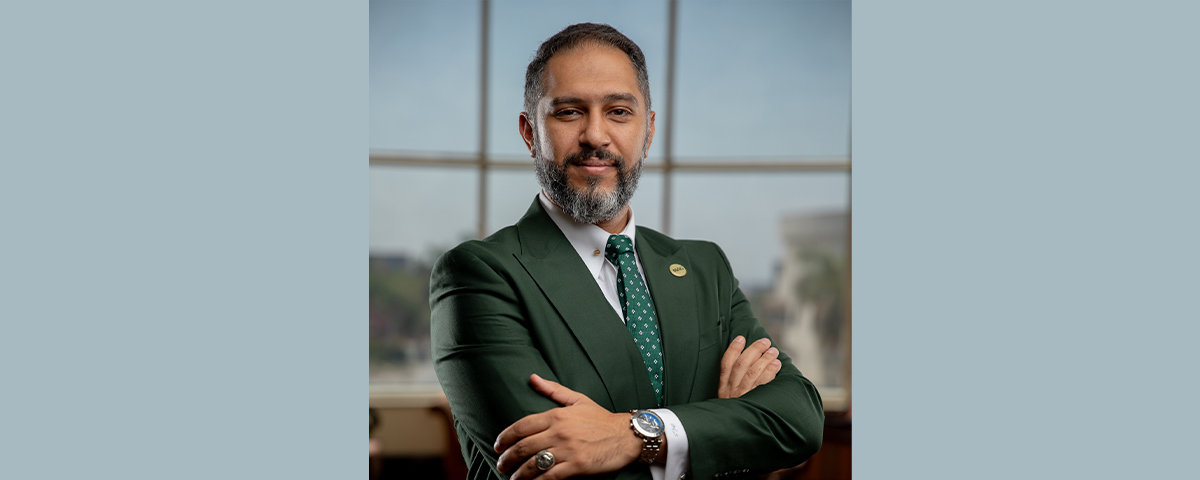
By Dr. Nour El-Deen Reda El-Serougy
Trainer at Innovation Experts Real Estate Institute and CEO &
Managing Partner Pioneer Elite Properties.
In an age wherein capital has grown both more intelligent and more cautious, the investor no longer asks merely, “What may I gain?” He asks, with equal seriousness, “Where shall my wealth be treated with dignity, defended by order, and multiplied by time?” It is here that waterfront property in the United Arab Emirates rises above the level of mere indulgence and assumes the rank of strategy. My view is plain: in the UAE, a distinguished coastal asset is not simply a handsome acquisition for the eye; it is a disciplined instrument for capital preservation, income generation, and long-horizon appreciation. The sea, if I may speak with candour, has become one of the most persuasive balance-sheet advantages in the region.
The numbers alone compel attention. Dubai concluded 2025 with more than 270,000 real estate transactions worth AED 917 billion, the strongest performance in its history; then, in Q1 2026, it advanced yet again, recording AED 252 billion in total transactions, up 31 per cent year on year. Abu Dhabi, for its part, reported a record AED 142 billion in transactions across 2025, confirming that this is not a one-city story, but a federal narrative of confidence, regulation, liquidity, and global demand. When such transaction depth is paired with tax efficiency, residency pathways, world-class infrastructure, and an investor-friendly legal environment, waterfront assets become not speculative ornaments, but sovereign-grade wealth positions for private capital, family offices, and discerning individuals alike.
One must, however, distinguish between ordinary property and rare property. Waterfront real estate commands its premium because supply is finite, replication is impossible, and demand broadens with every cycle of wealth migration. The UAE has mastered the art of turning coastline into an economic thesis. Dubai Islands alone offers more than 20 kilometres of beaches; Palm Jebel Ali will add approximately 110 kilometres of coastline and over 80 hotels and resorts; Al Marjan Island in Ras Al Khaimah spans 23 kilometres of waterfront and 7.8 kilometres of beaches, with a substantial residential and hospitality pipeline already embedded into its master plan. This is not incidental geography. It is deliberate, monetisable scarcity.
Let us begin with Dubai Islands, for it is among the most compelling early-cycle waterfront opportunities in the emirate. In the first half of 2025 alone, Dubai Islands recorded AED 6.1 billion in sales from 1,936 transactions, placing it among Dubai’s most active coastal districts. Separate market tracking showed transaction volumes there rising by 156 per cent during 2025, which tells us something very important: demand is not merely present, it is accelerating. In broader Dubai waterfront markets, premium coastal districts were posting annual price growth in the region of 12 to 15 per cent by mid-2025, and Dubai Islands is benefiting directly from that migration of capital toward newer seafront stock with stronger upside than fully matured prime districts.
From an income perspective, Dubai Islands is already beginning to justify its promise. Market participants cited by Khaleej Times place long-term lease yields in the district at roughly 5 to 7 per cent annually, with short-term holiday-let performance ranging from around 7 to 10 per cent in suitable product. Another 2025 market report described prevailing rental yield on Dubai Islands at about 5 per cent, while arguing that the yield curve should strengthen as the district matures. This, to my mind, is the essence of the Dubai Islands proposition: today, one buys a seafront address at a stage where appreciation still has room to do the heavy lifting; tomorrow, one harvests the income advantages of a fully formed coastal community. It is the investor’s version of arriving before the orchestra begins.
Palm Jebel Ali occupies a yet grander category. It is not merely another luxury district; it is Dubai announcing, once again, that scale and ambition are still part of its economic vocabulary. Officially, the project spans 13.4 square kilometres, will add approximately 110 kilometres of coastline, support around 35,000 families, and feature more than 80 hotels and resorts. In 2025, Palm Jebel Ali overtook Palm Jumeirah as Dubai’s leading enclave for homes priced above AED 20 million, recording 517 ultra-luxury deals worth AED 12.4 billion and accounting for 21 per cent of all such transactions in the city. This is not passive curiosity from the wealthy; it is active conviction from global capital seeking the next trophy waterfront growth corridor.
Now, let us speak soberly about Palm Jebel Ali’s return profile. It would be intellectually lazy to describe it as a mature income play today, because it is not. It is, at present, more properly a capital-appreciation dominion than a stabilised rental machine. Yet that is hardly a weakness. Prime Dubai residential yields are still commonly spoken of in the 5 to 7 per cent range, while specialist Palm Jebel Ali forecasts point to 6 to 8 per cent as early phases reach practical maturity. The prudent investor should therefore underwrite Palm Jebel Ali as a future-income asset backed by present-day scarcity, luxury demand, and master-plan magnitude. In plain English: this is where one goes not because the story is finished, but because the best chapter has not yet been fully priced in.
If Palm Jebel Ali is the grand imperial wager of Dubai’s next waterfront era, then Al Marjan Island is the UAE’s most vivid example of how a tourism-and-lifestyle coastline can rapidly transform into an investment machine. The master plan itself is formidable: 23 kilometres of waterfront, 7.8 kilometres of beaches, more than 8,500 hotel rooms in the pipeline, 18,650 planned residential units, 450 planned holiday villas, and 1,530 keys within Wynn Al Marjan Island alone. Reuters has further reported Ras Al Khaimah’s ambition to attract 3.5 million visitors annually by 2030, up from 1.3 million in 2024, with the Wynn resort targeted to open in early 2027. The significance of this is unmistakable: Al Marjan is no longer a peripheral leisure address; it is becoming an institutional-grade tourism, hospitality, and residential ecosystem.
The financial performance has been equally persuasive. Khaleej Times reported that Al Marjan Island’s average price per square foot jumped 21 per cent year on year as of early 2026. ValuStrat reported Ras Al Khaimah residential capital values up 12.7 per cent year on year in Q4 2025, while CBRE noted that prime coastal apartments in flagship locations such as Al Marjan Island had reached a new cyclical peak. On the rental side, Al Marjan Island has shown the sort of momentum that serious investors do not ignore: median annual rents rose from AED 40,000 in April 2023 to AED 64,800 in April 2025, a 62 per cent rise in two years, while current yields in Al Marjan and Al Hamra Village were reported in the 5.5 to 5.8 per cent range. This is the rare case in which the income story and the appreciation story are advancing together, arm in arm.
Then we come to Al Reem Island in Abu Dhabi, which, in my professional judgement, is among the most balanced waterfront propositions in the country. It lacks some of the theatrical glamour of the giant leisure-led island master plans, but it compensates with something investors of substance deeply appreciate: economic gravity. ADGM’s completed integration of Al Reem Island added approximately 500,000 square metres of office space to its jurisdiction, brought over 1,100 entities under its framework, and extended the international financial centre across Al Maryah and Al Reem Islands to a combined 14.38 million square metres. That is not cosmetic development; it is institutional demand creation. Where commerce gathers, educated tenancy follows; where tenancy follows, rents harden; where rents harden, valuation resilience is born.
The performance data supports precisely that thesis. Bayut’s 2025 Abu Dhabi Sales Market Report identified Al Reem Island as the top choice for mid-tier apartments, showing a return on investment of 7.49 per cent, an average price of AED 1,352 per square foot, and an 18.9 per cent rise in price per square foot from 2024. ValuStrat, meanwhile, recorded average citywide gross yields in Abu Dhabi at 8.1 per cent in Q2 2025, with apartments yielding 8.5 per cent and apartment rents rising 12.5 per cent year on year. For the investor seeking a more balanced covenant between cash flow and appreciation, Al Reem Island deserves unusual respect. It offers what many investors claim to desire but rarely find in one address: credible yield, urban utility, and a macro story anchored in employment, regulation, and institutional expansion.
So where, then, should the astute investor place his emphasis? My answer is neither sentimental nor fashionable. If one seeks the greatest near-to-medium-term upside from a prestige coastal megaproject, Palm Jebel Ali stands in rarefied company. If one desires an early-mover Dubai waterfront position with improving income logic and considerable runway, Dubai Islands is profoundly attractive. If one wants tourism-fuelled acceleration with a live hospitality catalyst and increasingly evident rental pressure, Al Marjan Island is perhaps the most electrifying proposition in the federation today. And if one prizes steadier income married to strong but less speculative appreciation, Al Reem Island is a most civilised choice. Each serves a different temperament of capital; each belongs within the vocabulary of a modern UAE property portfolio.
Yet I must add one final admonition, for glamour must never be permitted to outrun discipline. Waterfront property is a magnificent asset class, but not every waterfront launch deserves the same reverence. The investor must examine developer pedigree, service-charge burden, handover realism, true net yield after operational leakage, and whether the asset is being purchased for immediate income, strategic flipping, or multi-cycle wealth preservation. In emerging districts such as Palm Jebel Ali and Dubai Islands, one must be particularly careful to separate projected yield from stabilised yield. In mature or maturing districts such as Al Reem Island and Al Marjan Island, one must study tenant depth, hospitality competition, and supply cadence with equal seriousness. The wise man does not buy the sea; he buys the right relationship between scarcity, liquidity, and time.
My conclusion, therefore, is emphatic. Waterfront property in the UAE ought not to be dismissed as a vanity purchase for the romantically inclined. It is, rather, one of the clearest expressions of modern wealth strategy in the Gulf: a union of prestige, utility, international demand, and measurable financial return. Dubai Islands offers the eloquence of early arrival. Palm Jebel Ali offers the audacity of scale and future supremacy. Al Marjan Island offers tourism-led acceleration and strong income relevance. Al Reem Island offers the noble balance of yield and metropolitan resilience. For the discerning investor, the shore is no longer a postcard. It is policy, mathematics, scarcity, and power—arrayed most beautifully at the water’s edge.